What Cisco's 1,279 job openings reveal about its priorities.
Cisco's observed openings rose 5.9% in seven days. Nearly three in five sit in engineering or software development, connecting the hiring footprint to a business increasingly focused on AI infrastructure, networking and security.
· Ghosted AI Research · Data through September 7
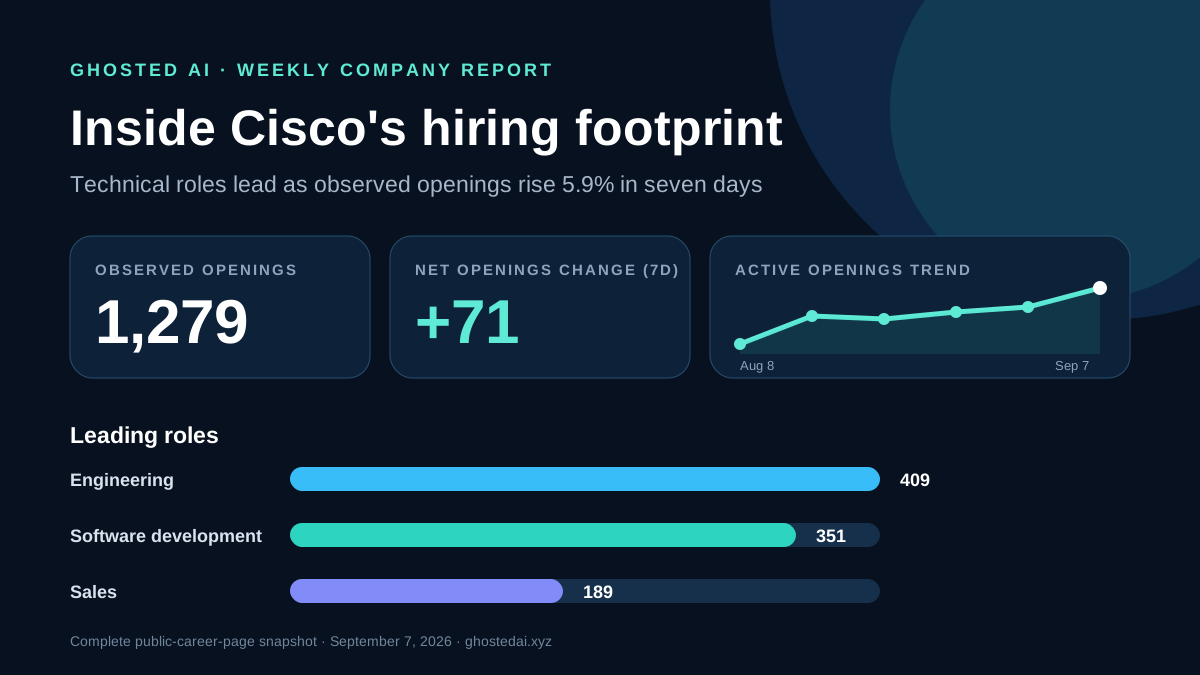
Observed openings
1,279
September 7 snapshot
Net openings change (7D)
+71
Up 5.9% from August 31
Largest named hub
Bangalore
219 observed openings
The seven-day increase is meaningful—but measured
Cisco had 1,208 active openings in the August 31 snapshot and 1,279 on September 7, a net increase of 71. Because both observations cover the complete public career site and are exactly seven days apart, this is a cleaner comparison than a change caused by expanding a previously sampled collector.
The result describes the size of the public openings set, not how many people Cisco hired. Positions can enter or leave a career site because of new demand, replacements, reorganizations, expiration or administrative changes. The defensible conclusion is that Cisco's visible openings expanded during the week.
Technical work accounts for 59% of openings
Engineering led with 409 observed openings and Software Development followed with 351. Together, the two categories accounted for 760 openings, or 59.4% of the company total. Sales was a substantial third category with 189 openings, or 14.8%.
That combination is revealing. Cisco needs a large workforce to build networking, security and collaboration products, but it also needs sales capacity to take a broad portfolio to enterprises, public-sector customers and service providers. The footprint looks less like a single-product expansion and more like the staffing pattern of an infrastructure platform company.
The skill mix points below the application layer
Python was the most frequently detected named skill, followed by C++, Linux, Java and Go. Kubernetes also appeared among the leading technical skills. Collectively, those technologies point toward systems software, network services, infrastructure automation and cloud-native deployment—not only conventional web application development.
Skill counts are intentionally conservative: Ghosted AI counts a skill only when it can be identified in available posting text. They show relative emphasis, not the number of openings that require no other skills.
Bangalore is the largest named hiring hub
Bangalore led named locations with 219 observed openings, ahead of San Jose with 112 and Minato, Japan, with 58. Bangalore alone represented 17.1% of all observed openings; San Jose represented 8.8%.
Cisco's career site also contains postings labeled only as “2 Locations” or “3 Locations.” We exclude those aggregation labels from the city ranking because they are not places. The named-location pattern nevertheless shows that Cisco's visible technical workforce demand spans both its Silicon Valley base and major Asia-Pacific engineering markets.
Company-reported context
AI infrastructure is becoming material to Cisco's business
Cisco reported fiscal 2026 revenue of $63.3 billion, up 12% year over year. Product revenue grew 16%, while services revenue was flat. In the fourth quarter, Networking revenue rose 28%, Security 14%, Collaboration 12% and Observability 6%.
The company's annual filing says AI-infrastructure revenue from hyperscaler customers represented approximately 6% of fiscal 2026 revenue, up from less than 2% in fiscal 2025. Cisco expects that business to be a significant fiscal 2027 growth driver. The filing connects Networking growth to AI infrastructure and data-center switching, while also describing increased commitments for Cisco Silicon One, memory and other products needed to meet hyperscaler demand.
Those disclosures make the engineering-heavy openings footprint directionally coherent: networking silicon, optics, systems software and security all require deep technical capacity. They do not prove that the seven-day increase came from AI programs, and Ghosted AI does not assign postings to a business segment unless the posting itself supports that classification.
There is also an important counterweight. Cisco authorized a restructuring plan with up to $1 billion in pretax charges while saying it would invest in growth opportunities including silicon, optics, security and AI. Openings and restructuring can therefore coexist as a company reallocates skills and locations. Public openings should not be treated as a proxy for total net headcount growth.
What the longer trend says
Observed active openings increased from 1,072 on August 8 to 1,279 on September 7. The path was not linear: the count reached 1,176 on August 17, slipped to 1,166 on August 24, then rose through 1,189 on August 26 and 1,208 on August 31.
That sequence is more useful than the latest number alone. It shows a month-long upward direction with normal week-to-week movement, rather than a single abrupt jump. More snapshots are still needed before calling it a durable acceleration.
What to watch next
Three signals will clarify the story: whether engineering and software remain close to 60% of openings; whether Bangalore continues to outpace San Jose; and whether systems-oriented skills such as C++, Linux and Kubernetes retain their prominence. A sustained rise across comparable snapshots would be stronger evidence than any one week's change.
Methodology and limitations
Ghosted AI observes public employer career pages over time. This report compares complete Cisco snapshots from August 31 and September 7, 2026. Counts describe visible postings, not hires or net employee growth. Multi-location labels are excluded from named-city rankings. Role and skill groupings are derived from posting text. Company results and strategy come from Cisco's public SEC filings; links between those disclosures and the openings footprint are explicitly presented as interpretation.