What NVIDIA's 2,698 job openings reveal about its priorities.
Engineering dominates NVIDIA's observed hiring footprint. Its role mix, technical skills and international hubs align with a company scaling AI infrastructure—but postings alone cannot prove why each position was opened.
· Ghosted AI Research
Observed openings
2,698
August 31 snapshot
Core technical roles
2,006
Software development + engineering
Largest named hub
Santa Clara
829 observed openings
The footprint is overwhelmingly technical
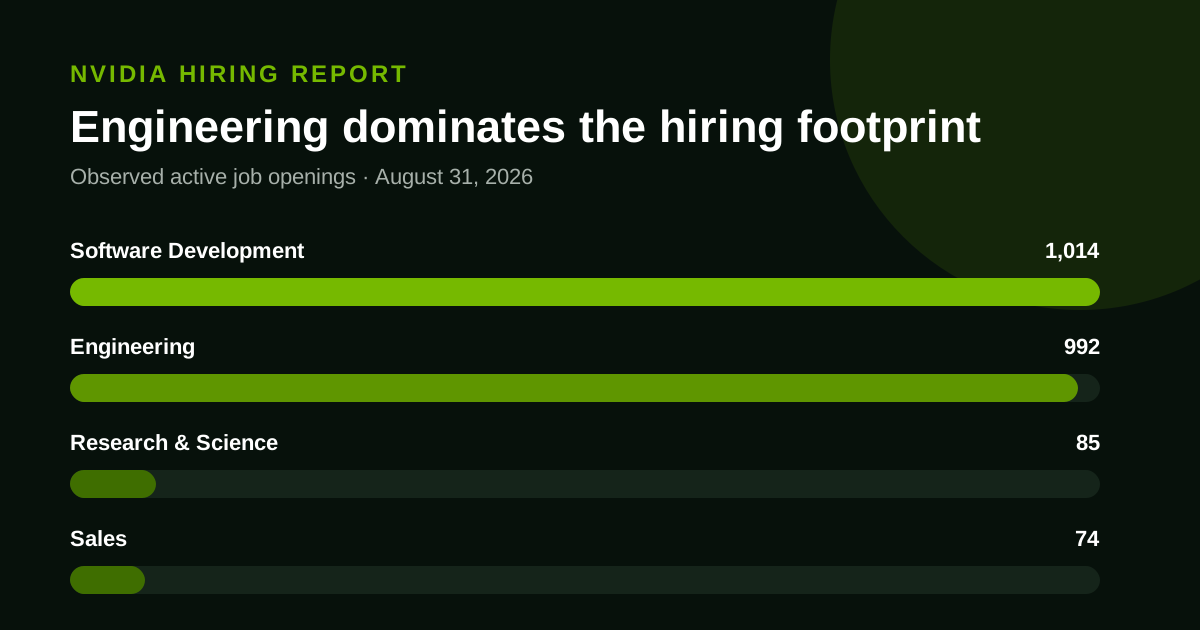
Software Development accounted for 1,014 classified openings and Engineering for 992. Together, those categories represented roughly three quarters of all observed active postings. Research and Science added 85 openings, while Sales accounted for 74. The imbalance matters: NVIDIA's visible demand is much more heavily weighted toward building products and infrastructure than toward expanding a broad commercial workforce.
This does not mean every technical opening belongs to the same product line. Job descriptions often support multiple platforms, and role classification is necessarily broader than NVIDIA's internal organization.
AI software appears throughout the skill signal
Among explicitly identified skills, CUDA appeared most often, followed by Generative AI, Large Language Models, Machine Learning and Linux. C++, Kubernetes, Python and PyTorch also appeared. Skill counts are conservative because a skill is counted only when it is identifiable in the posting; they should be read as evidence of emphasis, not as a complete census of every technical requirement.
The combination points to work spanning accelerated-computing software, model development and deployment infrastructure. It also helps explain why “engineering” alone is too broad a description of NVIDIA's hiring: the visible stack extends from low-level GPU programming to AI frameworks and cloud-native systems.
Santa Clara anchors a distributed engineering network
Santa Clara was the largest named location with 829 observed openings. Yokneam in Israel followed with 150, Bengaluru with 135, Shanghai with 85, Tel Aviv with 83, Taipei with 47 and Hsinchu with 45. Several postings listed multiple possible locations, so those entries are excluded from the named-city comparison.
The pattern is consistent with a global product-development network: corporate and engineering concentration in Silicon Valley, substantial engineering presence in Israel and India, and hiring near the semiconductor and systems ecosystem in Taiwan and China. That is an interpretation of the distribution—not evidence that every location serves a single business function.
Company-reported context
How the footprint relates to NVIDIA's business, products and expansion
NVIDIA reported second-quarter fiscal 2027 revenue of $96.2 billion. Data Center contributed $89.0 billion, and the company attributed its growth to the ramp of Blackwell Ultra infrastructure. That scale makes the concentration of openings in software development and engineering directionally consistent with NVIDIA's largest commercial engine. It does not establish that a particular opening was authorized because of quarterly revenue.
Product timing reinforces the same context. NVIDIA said Vera Rubin was ramping into full production and highlighted networking systems, inference accelerators and AI infrastructure around the platform. The observed prominence of CUDA, generative AI, large language models, machine learning, Linux and Kubernetes fits the technical breadth needed around an accelerated-computing platform: silicon is only one layer of a larger software, systems and deployment stack.
The geographic footprint also sits alongside announced expansion. NVIDIA reported partnerships to build sovereign AI infrastructure at gigawatt scale in Korea and said 35 new NVIDIA AI high-performance computing systems were in development across Europe. Its quarterly filing separately described significant commitments for manufacturing capacity, memory and data-center infrastructure. Openings across Taiwan, South Korea, Israel, India and Europe should therefore be watched as potential workforce counterparts to a widening partner and infrastructure network—but the postings do not identify which announcement, if any, created each role.
This context suggests a useful hypothesis for future snapshots: if NVIDIA continues moving new platforms into production and broadening AI-factory deployments, engineering, systems software and infrastructure skills may remain prominent across multiple regions. Ghosted AI will test that hypothesis against subsequent observed postings rather than treating it as a forecast.
What changed in the latest observation
Between August 26 and August 31, active openings increased by 46, from 2,652 to 2,698. Ghosted AI observed 157 postings enter and 131 leave the active set during that five-day comparison. This is not a seven-day measurement, and removed postings are not confirmed hires. The useful signal is modest net expansion alongside substantial posting turnover.
What to watch next
The next snapshots can test three questions: whether technical roles remain close to three quarters of the active footprint; whether Santa Clara's share changes as international locations expand; and whether CUDA and AI-model skills persist beyond individual posting cycles. Repeated observations will be more informative than any single weekly movement.
Methodology and limitations
Ghosted AI observes public employer career pages over time. Counts describe visible postings, not hires, headcount additions or vacancies approved in a specific quarter. A posting may list multiple locations. Role and skill groupings are derived from posting text. Business statements above come from NVIDIA's public filings and earnings materials; connections to the hiring footprint are labeled as interpretation.